
Grieving the Good War
My long-lost uncle and the difficult relationship between heroes and sacrifices.

Many of our guests on season one of Third Things First emphasized how important it is to let ourselves grieve as we seek to free ourselves from violence.
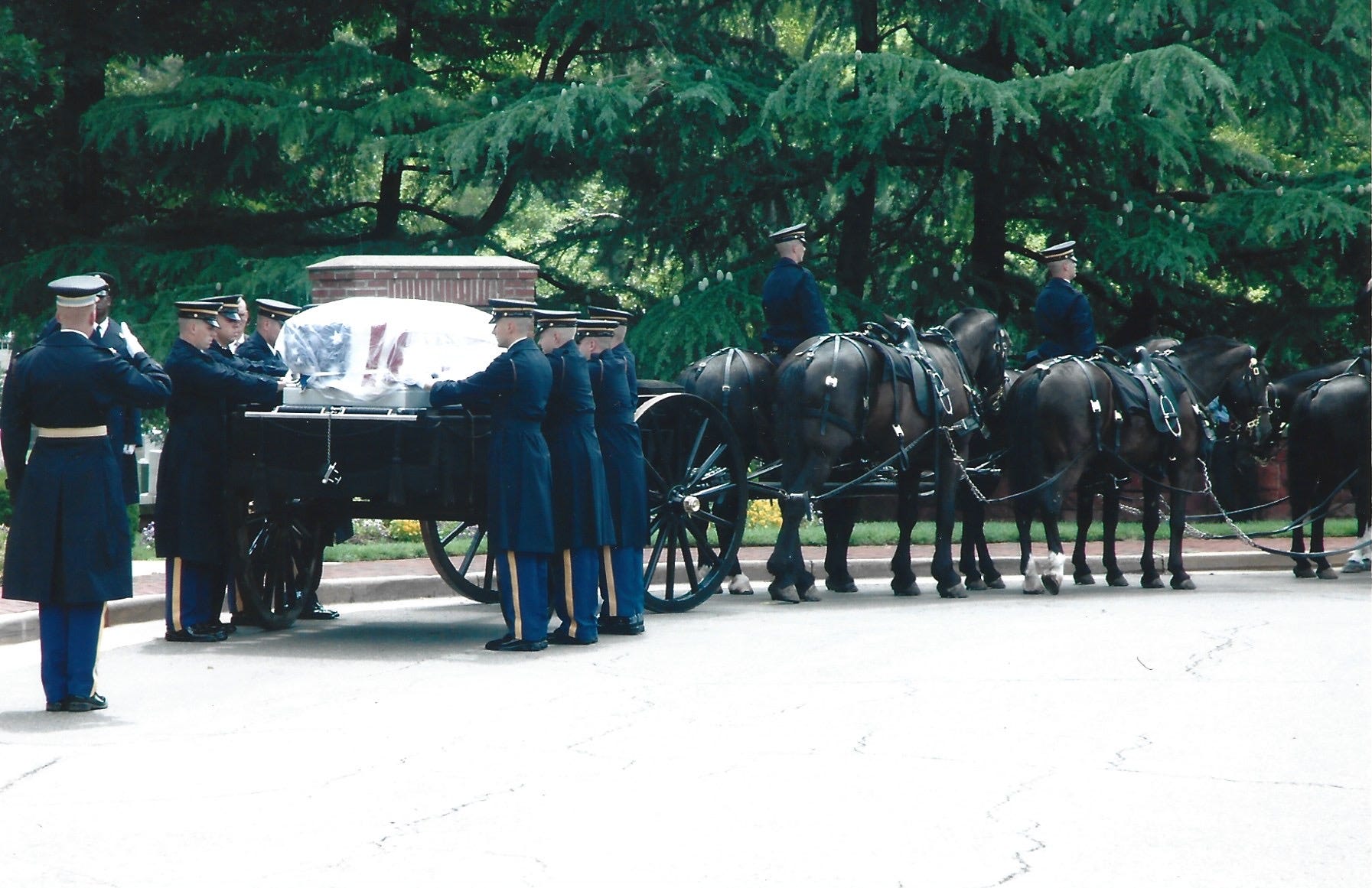
Twenty years ago, at Arlington National Cemetery—our nation’s graveyard for our war dead—I saw firsthand how violence shrouds itself in goodness and holds the work of grief hostage.
That was the day my father buried his long-dead brother, found after being missing in action for nearly 60 years.
My father and his older brother John both served in World War II. Dad was never deployed to active duty, but Corporal John A. De Carlo served as an assistant radio operator and gunner. On October 9, 1944, he was one of nine crew members aboard a B-24D Liberator on a training mission that failed to return to their base in Nadzab, New Guinea.
It was speculated that they encountered bad weather and crashed into a mountainside. No wreckage was found, and John’s body was not recovered.
John was reported as MIA, so there was no funeral—nor was there an endpoint to the grief. My grandmother never stopped hoping he’d be found alive, and for many years she’d see her son’s face in a crowd. But it always turned out to be stranger.
Then, in 2002—many years after my grandparents had passed—the U.S. Embassy in Papua, New Guinea reported that villagers had discovered two dog tags from a World War II crash site in the Morobe Province.
The site was excavated in 2003. The human remains found there included my uncle’s.
So I found myself at Arlington National Cemetery on June 27, 2006 with my dad, his two sisters, my sisters and cousins, along with the families of the 8 other crew members who had died with John.
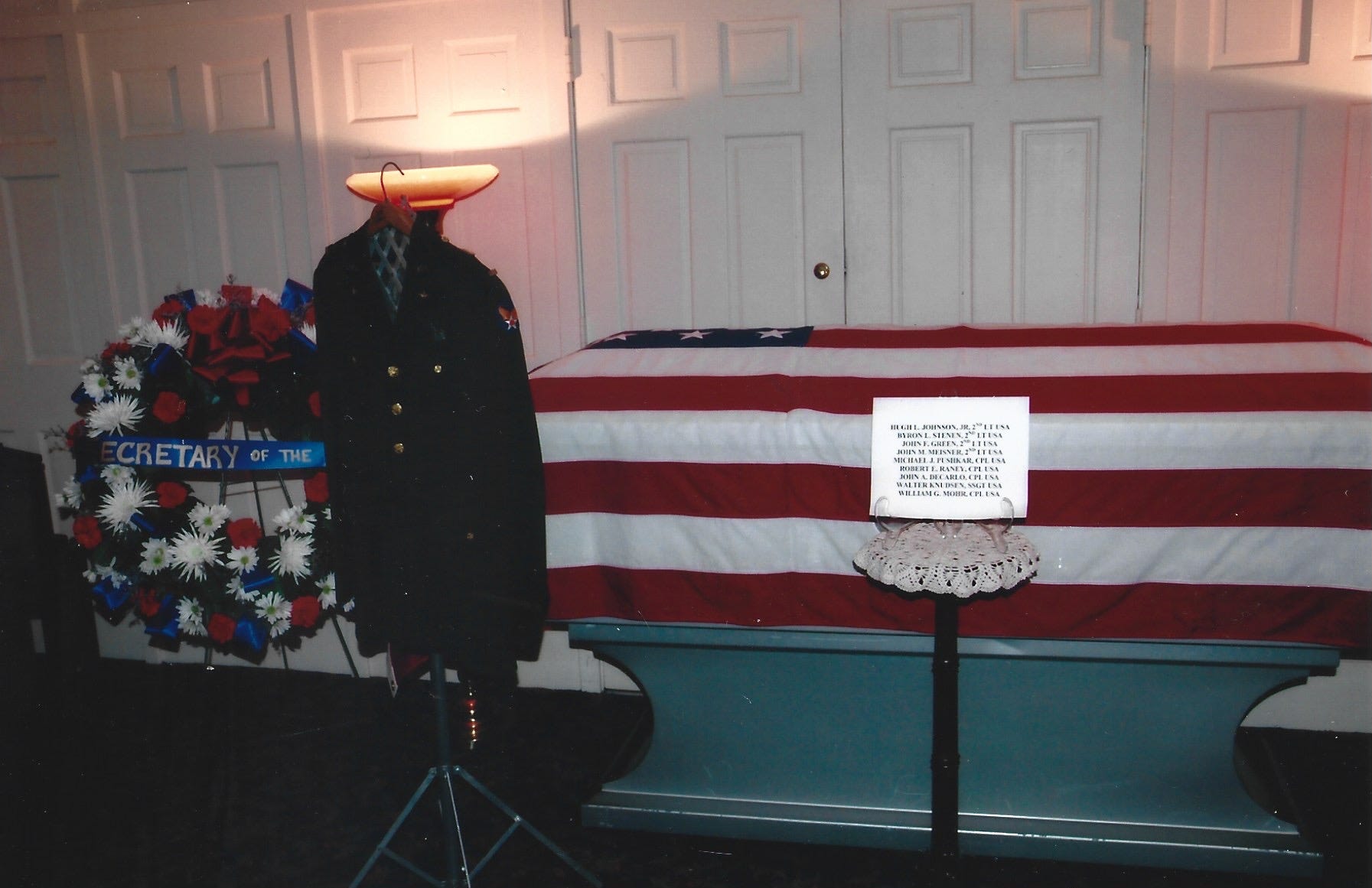
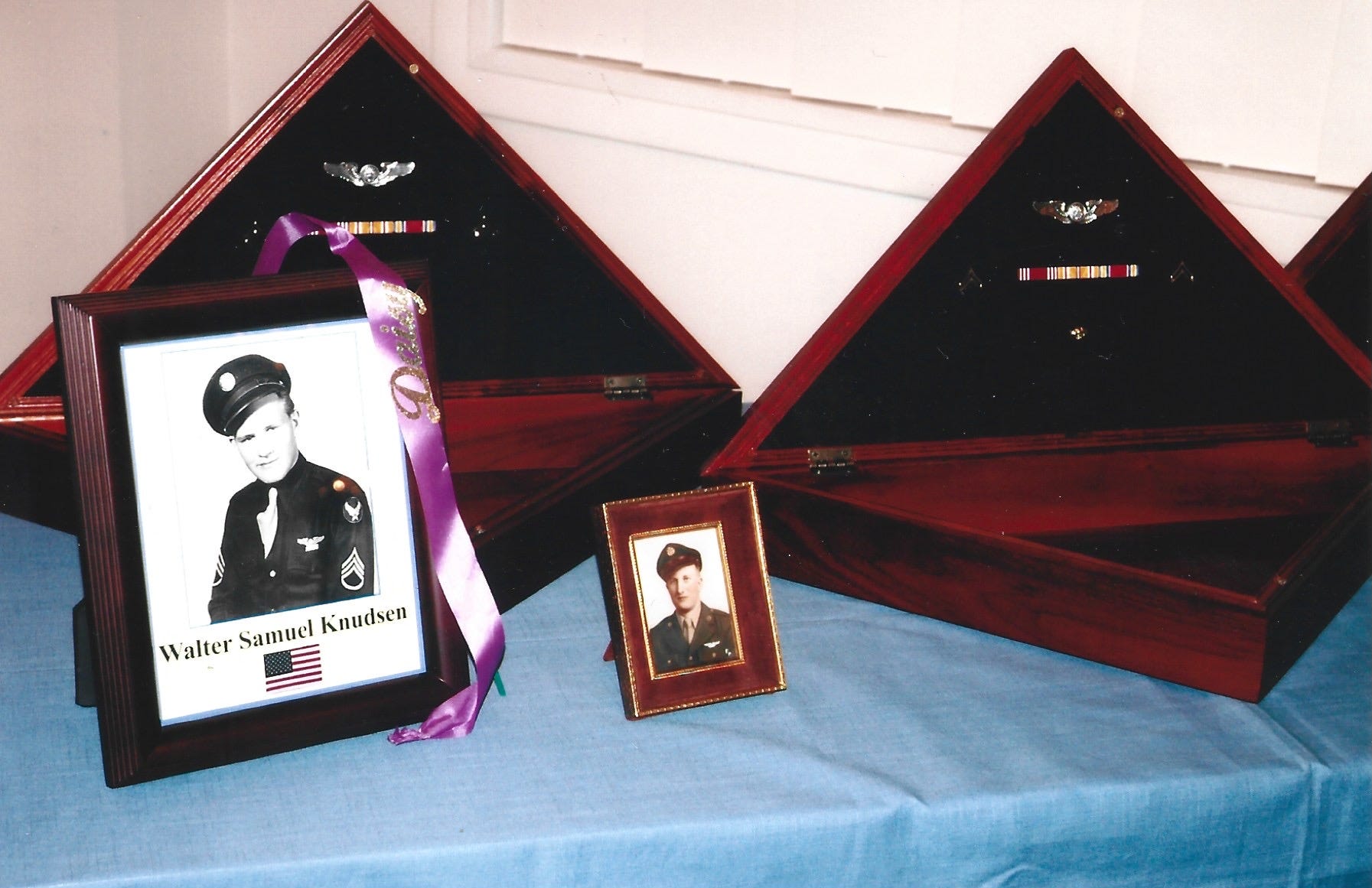
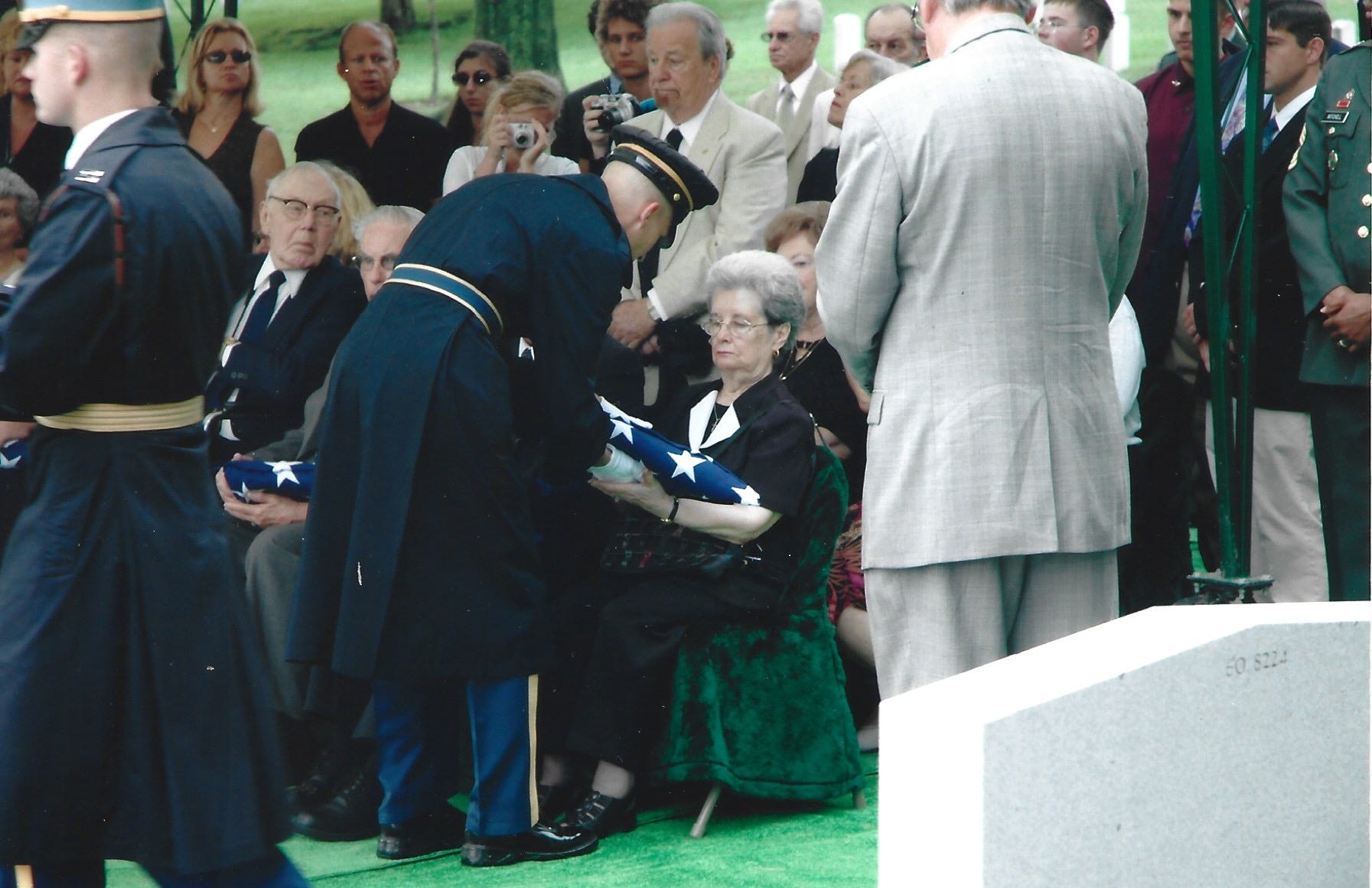
We were led into a room with a flag-draped coffin containing the remains of all 9 servicemen. A floral wreath from the Department of Defense stood to one side. Photos provided by the families sat on tables with 9 triangular boxes containing the folded flags that would be presented to each family at the graveside ceremony. It had the feel of a wake: hushed tones, memories shared, a few tears, and some laughter.
Before moving to the burial site, the uniformed officer from the Department of Defense asked if anyone would like to say a word of remembrance. Everyone who spoke paid tribute to the great sacrifice their loved one had made for their country and their families.
An undercurrent in all the comments was that defeating Nazi Germany was an unquestioningly good cause worthy of the ultimate sacrifice. WWII is remembered as the Good War, and the Americans who fought in it as the Greatest Generation. Those who remembered their loved ones spoke of the great honor and comfort that they would be interred at Arlington, along with so many heroes from past wars.
Then, my dad spoke.
He stood by the coffin and began by remembering the five Sullivan brothers who died in 1942, when the ship they were all serving on sank in the Pacific after being hit by two torpedoes. It was the single greatest loss to one family in the war, and it shocked the nation.
My dad believed he was not deployed to spare his family the tragedy of losing a second son in the war. He was alive today because his brother had died.
Yet he did not remember his brother’s death as necessary or good.
“When I look out at the rows and rows of white crosses,” he said, “I think, what a waste.”
In the tense silence after he spoke, my sisters and I held our breath. We weren’t surprised; we knew he was against war. But geez, Dad, we thought, read the room, why don’t you! These families had wrapped their grief in the flag, had consoled themselves with a narrative of necessary violence and the nobility of making the ultimate sacrifice.
But there was no way Dad was going to prop up that lie, no matter if speaking the truth caused a fresh wave of grief. I was never more proud of my dad — though I was sure he had offended everyone in the room!
My dad told me that, before John went missing, their mom was a happy, cheerful person. But that was not the woman I knew. My grandmother was quiet, and her smile was tinged with sadness at losing her first-born child when he was barely 25 years old. But beneath even that was another hidden, complex grief that is not allowed to surface when a country has survived a war: The unspoken grief of survivor’s guilt. This was the grief implicit in my dad’s story.
No one who heard my dad speak that day seemed ready to allow that deep grief to surface. Gena St. David (one of the guests I mentioned) also raises the specter of unprocessed grief as an obstacle to peace in her new book, The Nonviolent Brain. Gena makes the provocative claim that the awareness of others’ suffering, even suffering we don’t witness or are only vaguely conscious of, could be “contributing to a generalized free-floating anxious feeling” that is part of the background of our lives.

Gena believes that we turn away from violence done to humans, animals, and the environment to protect ourselves from feeling too deeply. She calls it “chronic numbing”. I believe the narrative of the Good War is a kind of numbing on the national level. My dad refused to numb himself to the tragedy of his brother’s death. Gena’s research reveals that my dad had taken the unexpected first step to living without violence: to move slowly and carefully from numbing to feeling.
Can a nation take that same step together?
Arlington Cemetery is a beautiful, haunted place. The cost of war is visible above ground, in the rows upon rows of white crosses. The work of grief goes on as people search, with map in hand, for their loved one’s burial site. My uncle and his crew are buried in section 60, grave #8334.
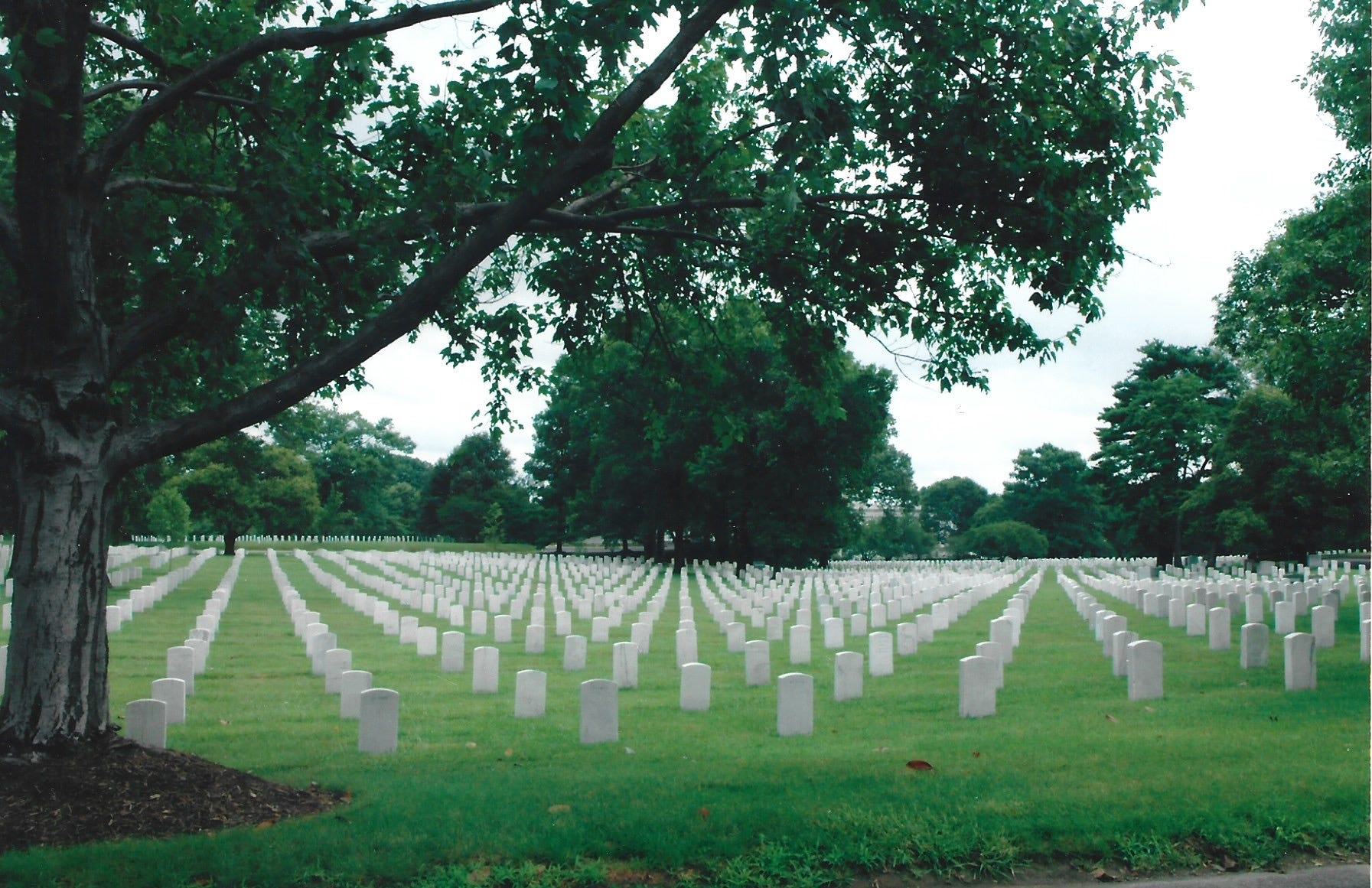
I wonder, though, if peace will remain elusive until we can create a space to both honor the dead, and to grieve the ways we have glorified their deaths.
Perhaps we avoid questioning the necessity of the next war to spare ourselves the grief of questioning the necessity of all the wars that came before.
This post is for people like me who advocate for the repudiation of war. Some who call us naïve or misguided might be persuaded by evidence, by stories about successful nonviolent movements or books about how all violence, even “good violence”, arises from scapegoating. But maybe they need something else. Maybe they need help bearing the pain of grief that will surface should they ever allow themselves to acknowledge it. I never met my Uncle John, but I feel his absence as something present and real, a loss that lingers like an old scar.
I hadn’t put it all together until I was writing this post, but I published the first edition of The Wicked Truth: When Good People Do Bad things six months after we buried my Uncle John at Arlington. Maybe my book, the podcast, and these blog posts are my way of working through what my dad said that day, and the fact that I also owe my life to John.
Gratitude is not enough. I owe my uncle a courage equal my dad’s:
To grieve that Arlington Cemetery is a wasteland, even if saying so means I offend everyone in the room.
What do you think? When you look at our war memorials, do you see monuments to heroism, or to unnecessary loss? Or to both? If both, how do you hold both realities together in your heart? I’d love to hear from you.
I want to post two works of art to express my feelings: picasso’s Geurnica and Edwin Starr’s song WAR (what is it good for, absolutely nothin).
Recently watched, The Pacific, Stalingrad, and Band of Brothers. There is Nothing good about war.
Heartbroken for our family, and all our families on either side. Such a fucking waste.
Thanks Suzanne. As a male boomer turning 80 years, and a veteran, I am amazed to find that during my youth I embraced war and the military as exciting and patriotic. My father was a WW2 veteran and I cherished his stories, his uniform and medals. I remember playing ’ war’ with my friends in the Ohio farm fields, BB gun in hand, and exploding firecrackers for realism. And watching TV westerns with patriot cowboys spinning chromed pistols. In my teens I realized I had embraced a youthful mind set of romanticized violence and how easy it had happened. Then my time came in 1968 when I was drafted into the US Army for a look at the waste and horror of war, especially for young people who believed in a false story. Unfortunately nothing has changed in 80 years.